How Grok 4.6 happened: Cursor's data flywheel
Grok 4.6 shipped on August 12 with the usual launch-day furniture: a benchmark table, a price, a one-line announcement. Elon Musk's own post was five words: "Grok 4.6 is a banger."
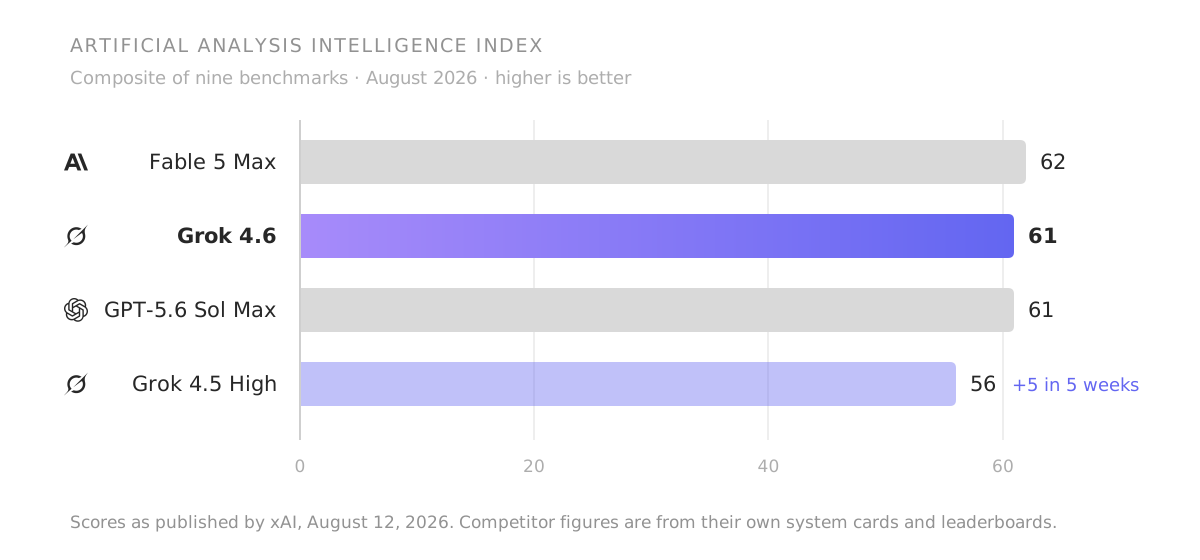
Most of the launch-day argument is about whether 61 on a composite index beats 62. That is the least interesting part. Six months ago xAI had lost all eleven of its co-founders and Musk was conceding in public that Grok was behind in coding. Grok 4.6 is the story of how the company caught up, and most of that story runs through Cursor.
This post follows the primary sources: the xAI release notes, the Cursor training write-up, the acquisition filings as reported at the time, and the benchmark pages. Where a tweet is the source, I link the tweet.
Six months, start to finish
The starting point was low. By the end of March 2026, all 11 of xAI's co-founders had left, and Musk admitted the company "was not built right the first time around" and that Grok was behind in coding. Anthropic held roughly half the AI coding market. Cursor, the most popular AI editor, was watching its own share slide.
Then the deals started. In April, SpaceX bought an unusual option: the right to acquire Cursor's parent company Anysphere for $60 billion, with a walk-away cost of $1.5 billion in fees plus $8.5 billion in computing resources. Cursor, which had said it was bottlenecked by compute, got access to the Colossus cluster in Memphis. SpaceX went public on June 12. It exercised the option two trading days later.
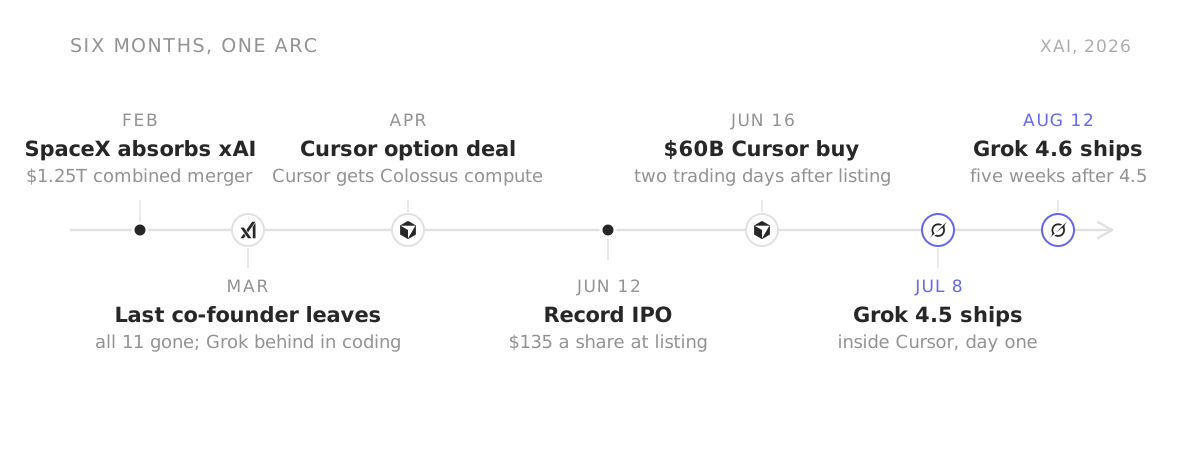
Grok 4.5 shipped inside Cursor on July 8. Grok 4.6 followed on August 12, five weeks later. Two frontier releases in five weeks, from a lab that had shipped nothing frontier-tier all year.
What $60 billion actually bought
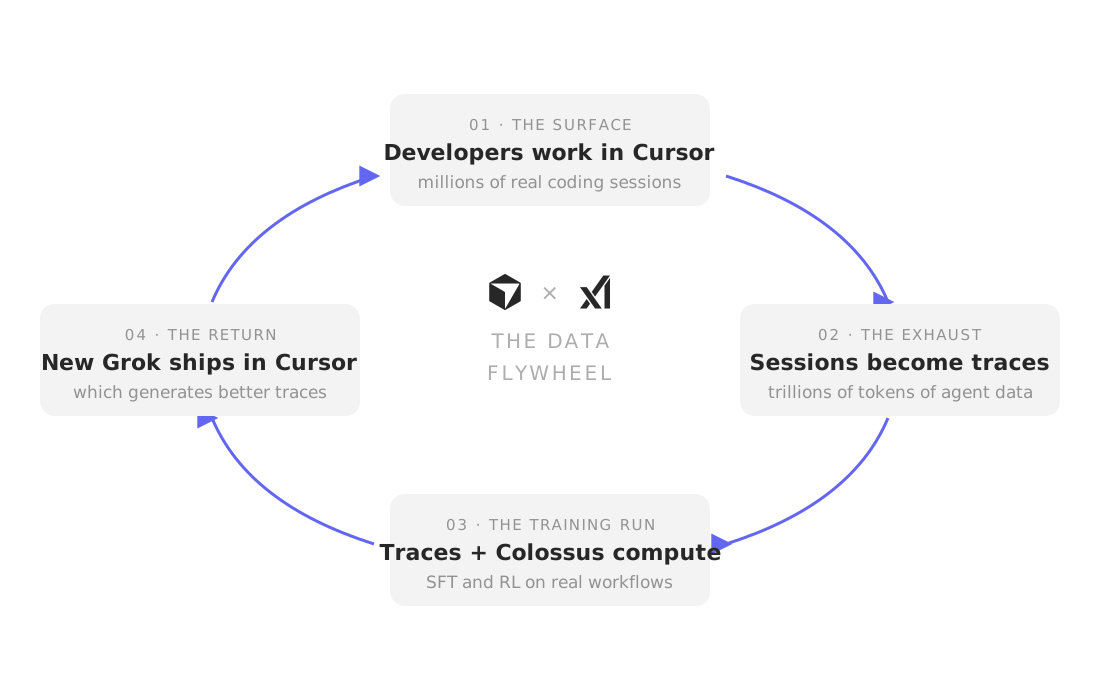
The editor is not the asset. Editors are replaceable, and Cursor's own market share was falling when the deal closed. The asset is what millions of developers generate inside the editor every day: full records of how work happens. Prompts, tool calls, multi-file edits, the agent attempt that got rejected, the human correction that followed. This kind of data barely exists on the public web.
Cursor said it plainly in the Grok 4.5 announcement: training included "trillions of tokens of Cursor data which capture a wide-range of user interactions with codebases and software tools." The model learned from existing software and from watching how developers and agents actually behave in it.
Pretraining text is abundant. Records of real multi-step agentic work are scarce, and they are exactly what reinforcement learning needs. That is why every major lab now owns a coding harness: OpenAI has Codex, Anthropic has Claude Code, and xAI bought Cursor. One analysis at FourWeekMBA put the consequence bluntly: choosing which harness your team codes in is choosing which lab you are training.
Grok 4.5 was the proof of concept
Grok 4.5 is a mixture-of-experts model the two companies trained jointly, and the xAI announcement gives unusual detail about how. Tens of thousands of NVIDIA GB300 GPUs. Reinforcement learning across hundreds of thousands of tasks, mostly multi-step software engineering, with automated and model-based grading. An asynchronous training stack, so agent rollouts that run for hours keep learning going across the cluster.
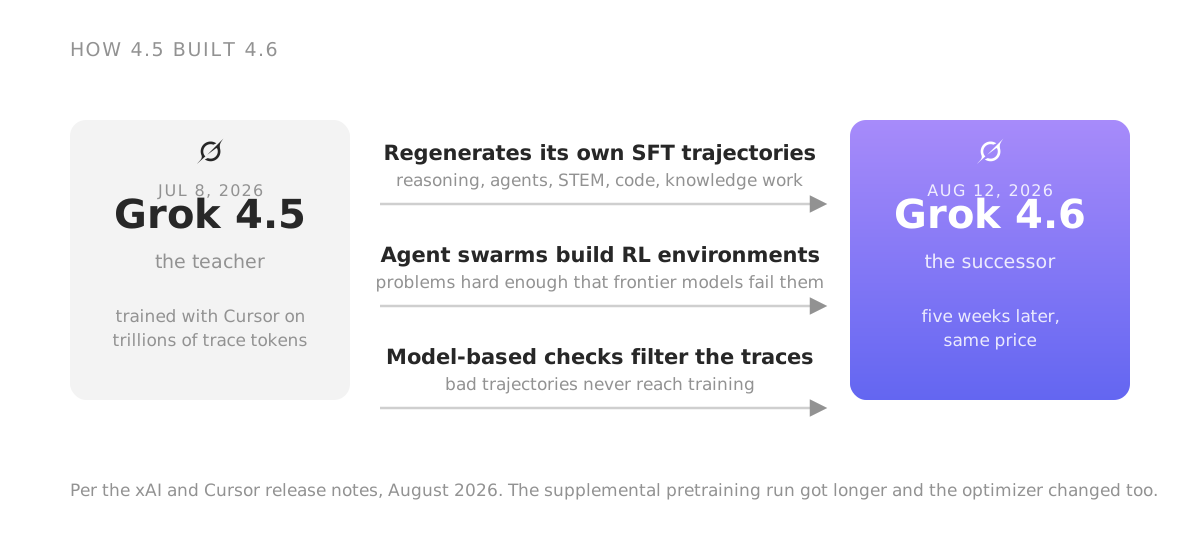
The detail I keep coming back to is the environments. RL tasks have to be hard enough that the current frontier fails them, otherwise the model learns nothing. Cursor built a distributed agent system that constructs these environments at scale: engineers specify a problem and how to verify a solution, and swarms of agents build, test, and refine the environment. Cursor estimates some of them would have taken teams of hundreds of engineers months to build. The previous model builds the gym for the next one.
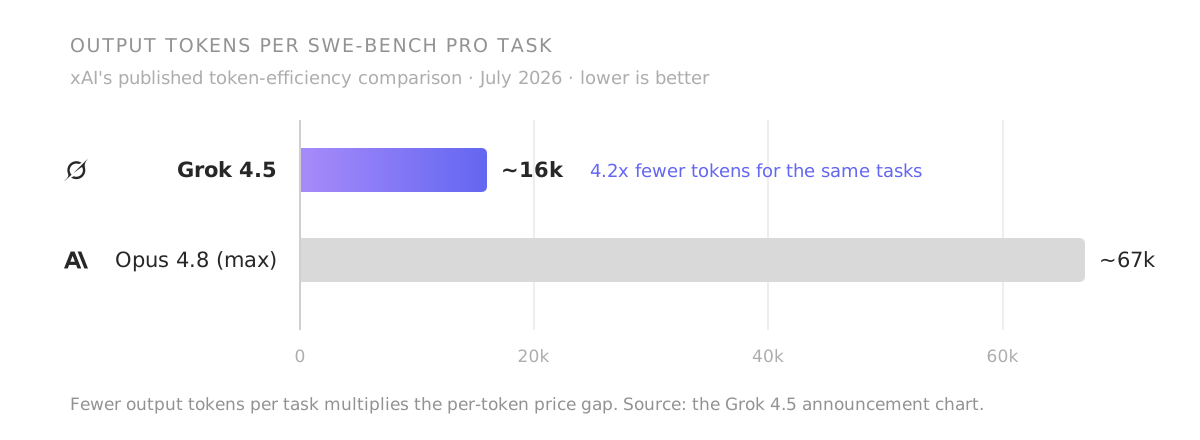
The result was not the smartest model in the world, and xAI mostly did not claim it was. Musk called it "roughly comparable to Opus 4.7, but much faster". The pitch was economics: 80 tokens per second, about half the steps per task, $2 per million input tokens and $6 per million output.
Reception was loud and split. The Hacker News thread ran to 1,502 comments. Investor Gavin Baker's line stuck: "Pareto dominant for coding by the numbers. We will see on the all-important vibes." Several developers who ran it head-to-head placed it between Sonnet and Opus rather than at the frontier. The price made everyone pay attention anyway.
Then Grok 4.5 built Grok 4.6
The five-week follow-up is almost entirely a post-training story, and the Grok 4.6 release notes describe a specific recipe. First, a longer supplemental training run than 4.5 got, using curated model-generated data for reasoning and technical concepts, plus a changed optimizer. Then xAI used Grok 4.5 itself to regenerate the supervised fine-tuning trajectories across reasoning efforts, agent harnesses, STEM, software engineering, and knowledge work, and filtered the bad traces with model-based checks.
Reinforcement learning got wider too: general coding and knowledge work, plus purpose-built environments for kernel optimization, web development, and computer-aided design.
The behavior change xAI reports is the part worth testing yourself: on long trajectories, 4.6 started checking its own work before moving on, and its first pass on visual and interactive projects got noticeably stronger. A model that self-verifies changes what your agent harness has to wrap around it.
One thing the announcement never states is a parameter count. Community reporting points to the same foundation as 4.5 with the gains coming from the recipe, but xAI has not confirmed scale either way. The claim it does make is narrower and more checkable: five more points on the composite index, at the same price.
The numbers, caveats attached
Across the ten evaluations xAI published, 4.6 beats 4.5 everywhere, usually by a lot. Against the top tier it trades wins. It leads on GDPVal-AA v2 at 1753, AA-Briefcase at 1577, and the Harvey legal benchmark at 15.8 percent. It loses DeepSWE at 65.9 percent against GPT-5.6 Sol's 73, and Terminal-Bench badly: 26 percent against roughly 34 for both rivals. Terminal-Bench measures real terminal work, and that gap is not a rounding error.
Two caveats belong next to every number. The scores are self-reported, with competitor figures taken from published system cards rather than xAI reruns. And trace-trained models make benchmarks slippery in new ways: Cursor disclosed that an old snapshot of its own codebase accidentally leaked into 4.5's training and inflated its CursorBench score. They caught it, removed it, and said so in a footnote, which is more honesty than the industry norm.
Independent numbers exist and roughly agree. Artificial Analysis measures Grok 4.6 at 61 on its index, sixth among 183 models, with a 500k context window. Running the full index against the model cost them $1,068 in tokens, which says something about what evaluation itself now costs.
The price is the strategy
Grok 4.6 costs $2 per million input tokens and $6 per million output below 200k context, doubling above that, with a fast variant at twice the price. For comparison, commenters on the launch thread lined up the frontier: Opus 4.8 at $5 and $25, GPT-5.5 at $5 and $30, Fable 5 at $10 and $50. I looked at how these per-token menus actually translate to bills in the OpenAI versus Anthropic pricing breakdown; the short version is that output tokens dominate agent workloads, and $6 output is unusually low for this tier.
Token efficiency multiplies the gap. If the model finishes a task in a quarter of the output tokens at a third of the output price, the per-task cost difference is much larger than the price list suggests. That is the arithmetic behind Artificial Analysis measuring Grok 4.5 at $0.49 per completed task, about 90 percent cheaper than the models ranked above it. The same logic applies to estimating any LLM API bill: tokens per task matter more than price per token.
One wrinkle the Hacker News crowd caught: cached input costs $0.50, which is 25 percent of the input price. US frontier labs typically price cache hits near 10 percent, and long agent loops are dominated by cached context. In real agentic workloads the advertised gap narrows. It does not close.
What to watch
xAI is running two experiments in parallel. Grok 4.6 tests how much a fixed foundation improves when you rebuild the recipe on top of it. Grok 4.7, which Musk says arrives within weeks at a larger scale, tests what a bigger base adds. He has promised it will be "better than 4.6 in every way, except slightly slower to serve." The stated targets are Opus 4.8 and Kimi K3, the 2.8-trillion-parameter open-weights model this release was partly a response to.
The unresolved question sits under the training data. Cursor sessions contain proprietary code and internal architecture decisions from companies that adopted the editor long before SpaceX owned it. Neither company has documented which user cohorts or consent settings fed the pipeline. As more labs train on harness traces, someone is going to litigate this.
My suggestion is to watch the flywheel, not the index score. If the next model lands within weeks at the same price, the recipe is compounding and the traces are doing their job. If 4.7 arrives slower or pricier than promised, the cheap-frontier positioning was a market-share push, not a cost structure. Either answer will show up by autumn.